The James Webb Space Telescope’s early images revealed a multitude of tiny, intensely red sources that astronomers have nicknamed ‘little red dots.’ Each dot occupies just a pixel yet shines with the brilliance of an entire galaxy, and they appear in nearly every Webb field of view. Their extreme redness and compact size posed an immediate puzzle: how could such luminous objects be so small in the young universe? Initial speculation ranged from distant galaxies to exotic phenomena, but the dots’ uniformity and brightness demanded closer inspection via spectroscopy to uncover their physical nature.
Two competing interpretations have emerged from the spectral data. One camp views the little red dots as ordinary supermassive black holes whose broad hydrogen emission lines arise from gas whirling at high velocities around the black hole, while dust in the host galaxy reddens the observed light by scattering blue photons. The alternative hypothesis, advanced by teams led by Anna de Graaff and Rohan Naidu, suggests the dots are ‘black hole stars’—massive envelopes of hydrogen gas powered by a central black hole. In this model, the black hole’s gravitational energy heats the surrounding hydrogen, driving outward radiation that prevents collapse; the hot stellar‑like surface produces a Balmer break and a smooth red hump characteristic of a ~5,000 K surface, while the gaseous cocoon suppresses X‑ray variability and stabilizes the emission.
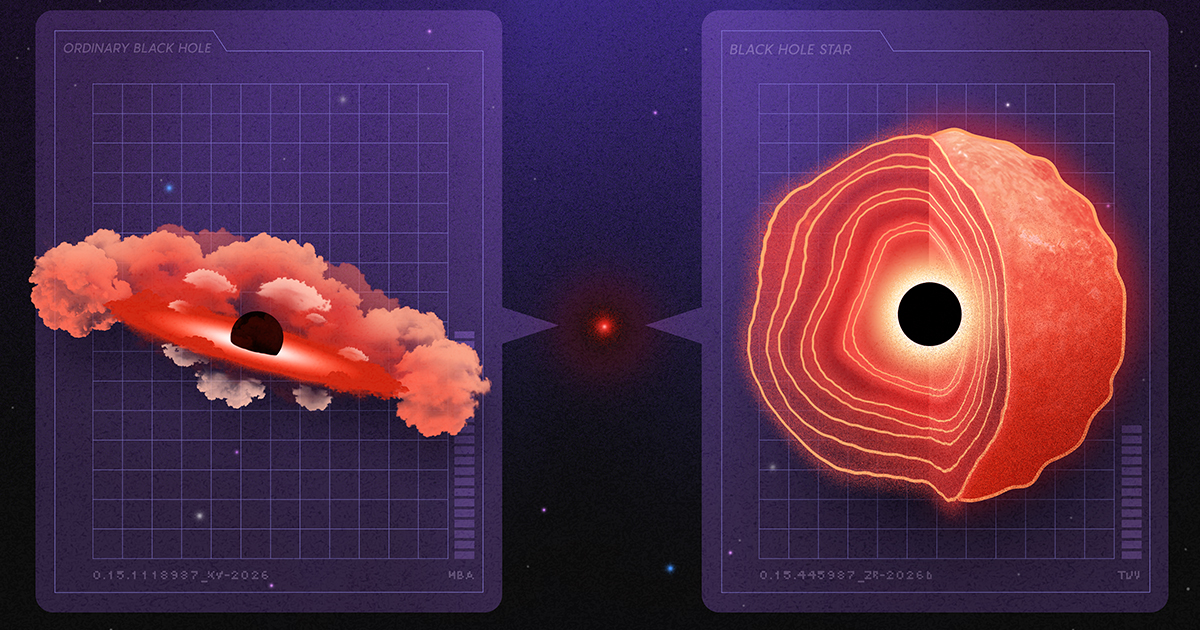
This image visualizes the black hole star model described in the article, wherein a central black hole heats a massive hydrogen gas cocoon to produce the observed red spectra and stable emission of little red dots.
The debate remains active because each side can account for different subsets of the observations. Proponents of the black‑hole star idea point to the pronounced Balmer break and the lack of rapid flickering or strong X‑ray emission as signatures of a stable, star‑like outflow. Critics, including Roberto Maiolino of the University of Cambridge, argue that standard black holes embedded in dense dusty tori or viewed edge‑on can reproduce the same red spectra, and that electron scattering in the interstellar medium also contributes to the observed line broadening, meaning the data do not require a novel stellar‑black‑hole hybrid. As of now, the observations admit both explanations, and further Webb programs are aimed at resolving whether the little red dots represent a new astrophysical stage or merely the extreme end of known black‑hole populations.