The ancient Egyptian god Set is often shown with a mysterious animal perched atop his head, a creature unlike the clearly identified falcon of Horus, the jackal of Anubis, or the ibis/baboon of Thoth. Depictions describe the Set animal as having angular upright ears, a stiff tail, and a long nose that curves downward, a combination that does not correspond exactly to any known living animal. This ambiguous portrayal has led scholars to refer to it simply as the “Set animal” or, in Greek sources, the “Typhonic beast,” underscoring that its true zoological identity remains unresolved.
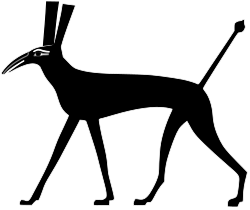
The image shows a visual representation of the Set animal as described in ancient Egyptian art, illustrating the ambiguous combination of features discussed in the article.
Over the years, researchers have put forward numerous candidates to explain the Set animal’s form. One leading suggestion is a slender hunting dog similar to the modern Saluki breed, whose squared ears might reflect the ancient practice of ear‑cropping performed on fighting or hunting dogs. Other proposals include various canines, pigs, camels, or more exotic creatures such as giraffes and aardvarks that Egyptians could have encountered on trade routes farther south. In the Late Period, around 500 BCE, Set is sometimes depicted with a donkey’s head, hinting that donkeys may have inspired the original image, while some scholars argue the creature could be extinct or even a purely symbolic invention rather than a real animal.
The difficulty in pinning down the Set animal stems from several factors. Successive foreign conquests led to Set being vilified, and many older images of the god and his distinctive animal were deliberately chiseled away or erased. Additionally, Egyptian artistic conventions allowed deities to shift forms over thousands of years, and the Set animal may have been intentionally left ambiguous to mirror the god’s dual role as both a force of chaos and a protector of the sun god Ra, who each night stood on Ra’s barge to slay the serpent Apep. As a result, the true zoological identity, if any, remains uncertain, leaving the Set animal as a lasting emblem of ancient Egypt’s complex mythological landscape.