Microsoft has designated Rust a "Tier-1 language" for internal engineering, according to a guest post published on the Rust Foundation site on September 10, 2026, by Victor Ciura, a Principal Engineer on the Rust tooling team within Microsoft's developer division. The post is first-party material: it reports what Microsoft says about its own practices, not an independent assessment. It opens by noting that Rust has been of strategic importance to Microsoft for some years, including a keynote by Azure CTO Mark Russinovich on the company's future for native code and millions of dollars in investments in the Rust Project.
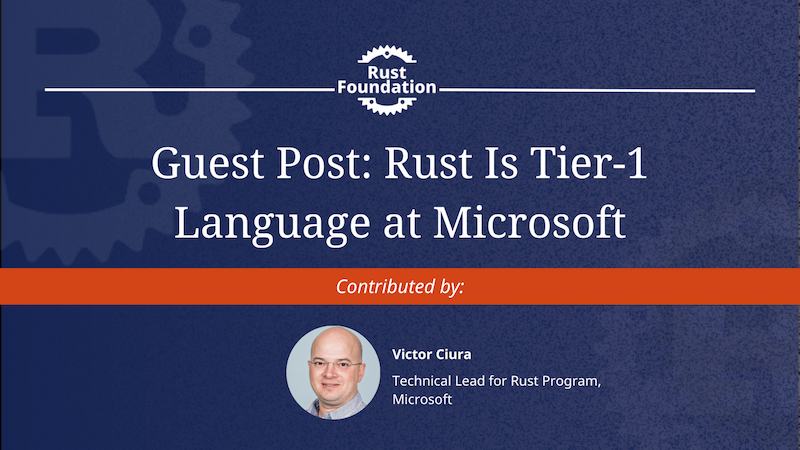
The guest post published on the Rust Foundation site details Microsoft's Tier-1 language designation for Rust internal engineering

First-party guest post by Microsoft engineer Victor Ciura on the Rust Foundation site explaining Tier-1 language status
Tier-1 status is an internal engineering classification, not a public language release. In practice it means Rust teams at Microsoft now have a "paved path" from local development to production: secure supply-chain builds of the Rust compiler (rustc) and its standard library, developer tooling, quality workflows, deep integration with the Windows platform, and compliance with the Security Development Lifecycle (SDL) requirements that Microsoft software must meet. The post lists C++, C#, and TypeScript as the languages that already hold this status, and says Rust now sits among them as one of the best-supported languages for internal development.
The technical centerpiece is a new compiler component called rustc_codegen_utc. To understand it, it helps to know how rustc is organized. rustc is built so that different "backends" can take its shared internal representation and emit machine code for different platforms. The three existing backends in the same architectural family are rustc_codegen_llvm (the LLVM backend), rustc_codegen_gcc (GCC), and rustc_codegen_cranelift. rustc_codegen_utc is the fourth: it plugs into the same backend interface and routes rustc's output through the MSVC backend, also known as "UTC" — the native Windows compiler toolchain that C and C++ have used for decades.

Visual representation of the Rust programming language project host on GitHub showing compiler development infrastructure
The stated result is a unified code-generation platform for Rust and C++ on Windows. Connecting rustc to MSVC means Rust inherits, rather than re-implements, the Windows-specific capabilities the MSVC stack has accumulated over many years. The post lists those capabilities as binary hardening and code-security features; post-link compliance, analysis, and servicing (including Hotpatch, Microsoft's mechanism for applying fixes to running binaries); Sample Profile Guided Optimization (SPGO); debugging and crash-dump analysis; profiling; diagnostics; and coverage tooling.
This matters because most of Microsoft's production code is still C++. The post argues that a shared backend minimizes duplicated engineering: when MSVC and Windows add new code-generation, security, diagnostic, or servicing features, those investments land on a common foundation for both languages. For hybrid Rust/C++ projects — which the post says many systems will use "for years to come" — a shared backend means both sides of a system participate equally in the same development, validation, diagnostic, and servicing workflows. The author's bio further describes his work as building the compiler toolchain and libraries needed for the "broader oxidation effort across the organization," Microsoft's push to introduce Rust into existing C and C++ codebases.
The post is careful about what it does not solve. Codegen, platform quirks, ABI (application binary interface), exception handling, and post-link tooling are, in its words, "only half" of the interop challenge. High-fidelity language-level interop — foreign-function-interface (FFI) contracts, bindings, language semantics differences, and build-system integration — remains an active problem both inside Microsoft and across the industry. The post points to the Rust Foundation's Interoperability Initiative as a catalog of that problem space and ongoing community work.
On rollout, the post says rustc_codegen_utc has been production-ready since early 2026 and has been self-hosted since Rust 1.90, meaning the compiler can compile its own source. It is part of a broader internal "Rust Paved Path" that includes secure supply-chain builds of rustc and the standard library, integration with local development and production pipelines, and common quality and compliance workflows. More than 100 Microsoft project repositories build with it today, with adoption continuing each week.
Caveats. The source is a first-party guest post by a Microsoft engineer published on the Rust Foundation's site; it reports Microsoft's own claims and does not provide independent verification of the Tier-1 designation or its operational impact. It offers no performance benchmarks comparing rustc_codegen_utc to the LLVM backend for real-world workloads, does not quantify how many of the 100-plus repositories are Rust-only versus hybrid, and does not address automated C-to-Rust conversion efforts. Whether the Tier-1 designation changes day-to-day development for any given team is not established by the post.