Qwen3.8 27B is a 27-billion-parameter language model from the Qwen3.8 series. The full BF16 (16-bit floating-point) variant of this model occupies approximately 55 GB, exceeding the memory capacity of most consumer-grade GPUs.
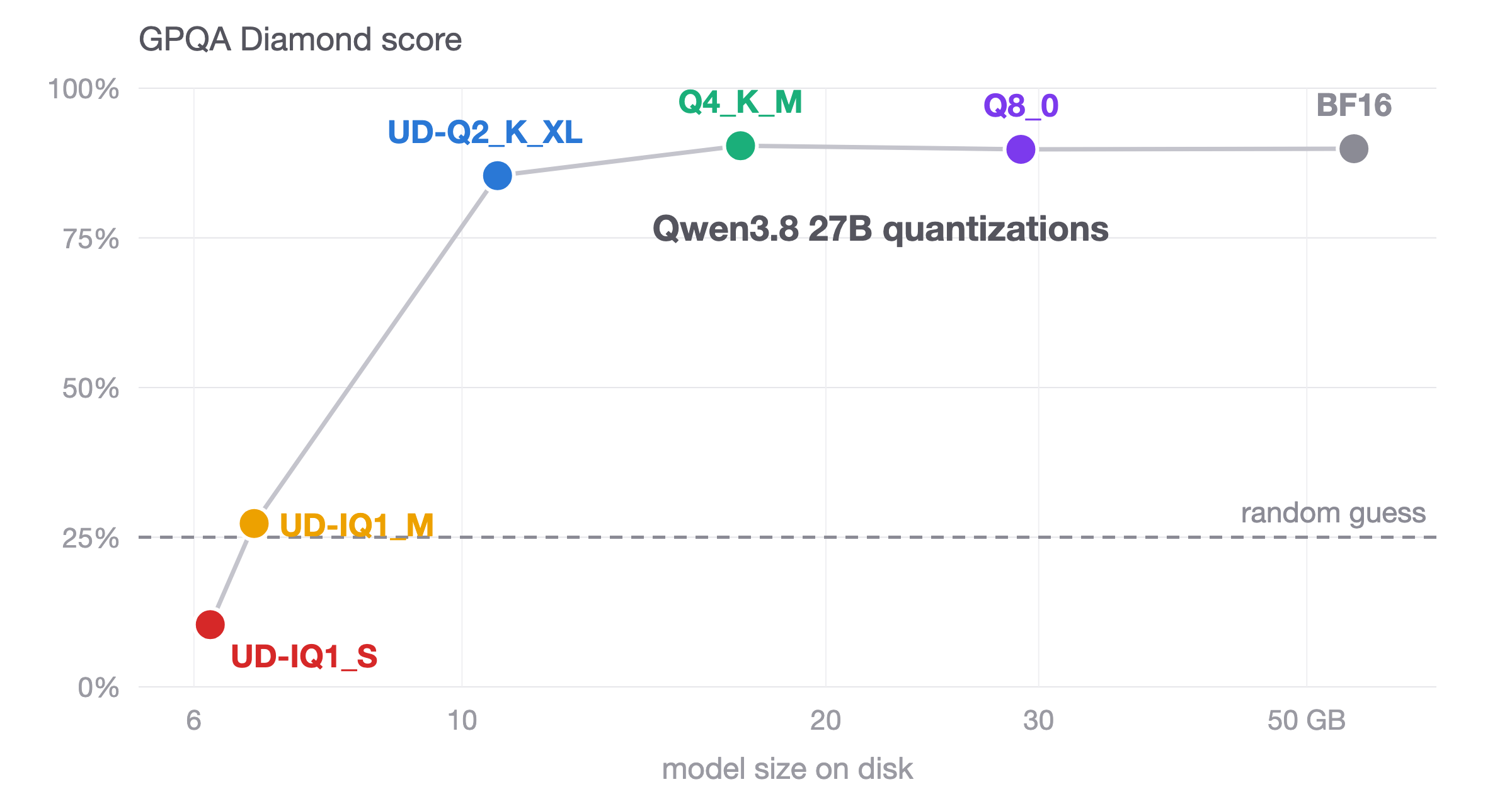
The article opens by introducing Qwen3.8 27B as a 27-billion-parameter model whose full BF16 variant requires approximately 55 GB, exceeding most consumer GPU memory. This title card summarizes the core finding that 4-bit quantization preserves quality while 1-bit collapses to random-chance performance.
To run the model on consumer hardware, the blog post by Quesma benchmarked several GGUF quantization levels. The quantizations tested were Q8_0 at 29 GB, Q4_K_M at 17 GB, UD-Q2_K_XL at 10.7 GB, and the minimal UD-IQ1_S at 6.2 GB. Quantization reduces model size by lowering weight precision, but it also affects the model's output quality on standard benchmarks.
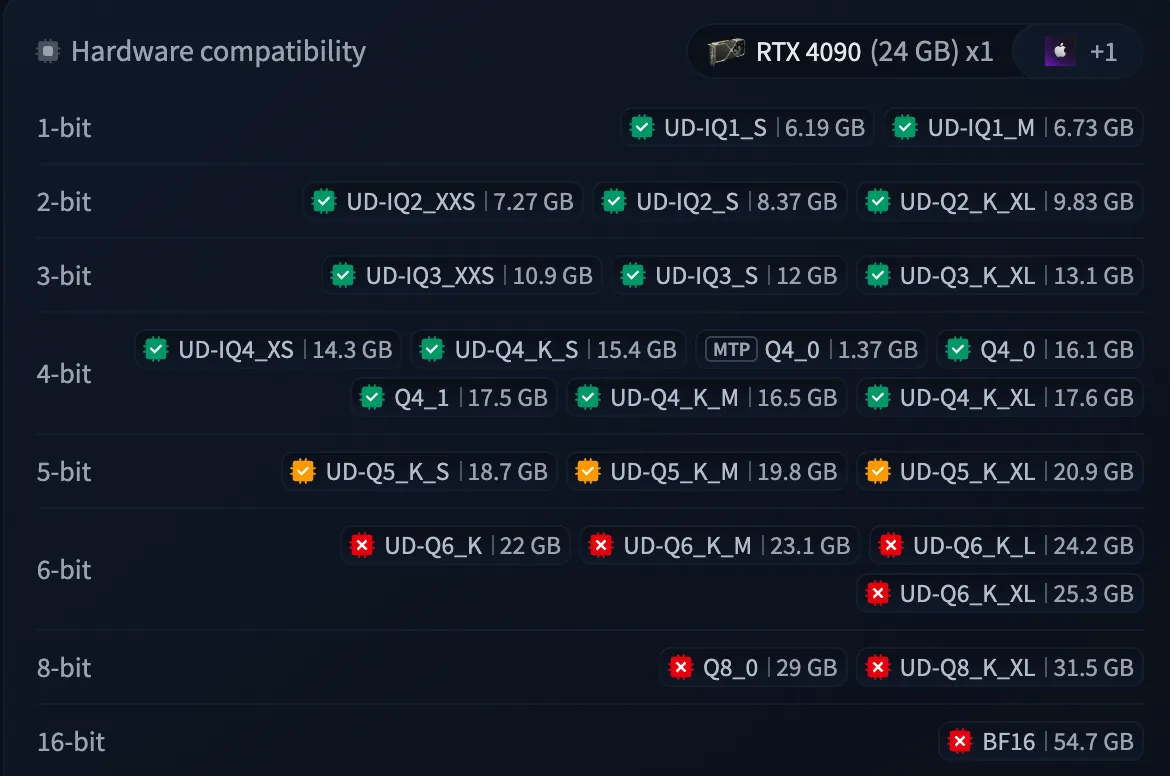
The second paragraph details the specific quantization levels tested: Q8_0 at 29 GB, Q4_K_M at 17 GB, UD-Q2_K_XL at 10.7 GB, and UD-IQ1_S at 6.2 GB. This screenshot from the Hugging Face repository shows the exact quantization variants Unsloth published, matching the ones benchmarked in the article.
On the GPQA Diamond benchmark (graduate-level science questions), the results demonstrated a nonlinear decline. The full BF16 model and the 4-bit Q4_K_M variant produced comparable results, with the 4-bit version matching the full model. At 2-bit, scores dipped slightly. At 1 bit, the model performed around random chance, with scores near the random-guessing threshold. Longer reasoning efforts worsened the 1-bit results, as the model more often reasoned until its token budget was exhausted and returned an empty answer.
On instruction-following tasks (IFBench), the blog post reports no measurable change between quantization levels down to a decent 2-bit variant (under 11 GB). Context was limited to around 4k tokens in these tests.
For the agentic coding benchmark Terminal-Bench 2.1 (89 tasks, 3h timeout, xhigh effort), the 4-bit Q4_K_M variant replicated the stated BF16 result. Only the 2-bit UD-Q2_K_XL showed a noticeable decline in performance, though it still operated at the level of Opus 4.7 or Gemini 3.1 Pro. On the solved tasks, the 2-bit model took roughly the same number of turns as BF16 but wrote about a quarter more tokens.
The benchmarks used a fixed F16 KV-cache regardless of model quantization, weighing approximately 2.3 GB per 32k tokens of context. Runs were conducted on Modal GPUs: NVIDIA L40S (48 GB, the same Ada Lovelace chip as the RTX 4090 but with twice the memory), H100 (80 GB), and H200 (141 GB). The author burned approximately $3,000 in GPU time running these benchmarks. An earlier build of llama.cpp from 16 August 2026 was required; earlier builds do not work for this model.
Unsloth provided the quantizations: v2 for the 2-, 4-, and 8-bit models, and v3 for the 1-bit models. Unsloth replaced the v2 files on 19 August 2026, so the exact files used for most tests are no longer available.
The author concludes that for most tasks the 4-bit Q4_K_M should be good enough without any noticeable difference; for some simpler tasks UD-Q2_K_XL should be more than fine. Since people report that KV-caches are more susceptible to quantization, the author may test it as well. But in general, the author believes that quantization should be embraced, rather than feared.