The release of the Linux kernel 7.2 on August 17, 2026, signaled a milestone in the project's development history. It was one of the most active cycles ever recorded, incorporating nearly 600,000 lines of code and 16,418 non-merge commits. While the 6.7 release previously held the record for the highest number of commits, that release was largely dominated by the merging of the bcachefs development history. In contrast, the high volume of activity in 7.2 was broad-based across the entire kernel, involving a record-breaking 2,652 developers.
Data from the LWN Kernel Source Database reveals a clear upward trend in the number of developers contributing to each release since the beginning of the Git era. However, the slope of this growth has shifted recently, coinciding with a surge in new participants. The 7.2 release broke a previous record by including 613 first-time developers. This influx of new contributors is accompanied by a notable increase in the use of Large Language Models (LLMs). While only 1,111 changes (under 7% of the total) carried official 'Assisted-by' tags, the actual number of LLM-assisted patches is likely much higher, as many developers do not supply these tags or maintainers do not actively query for them.
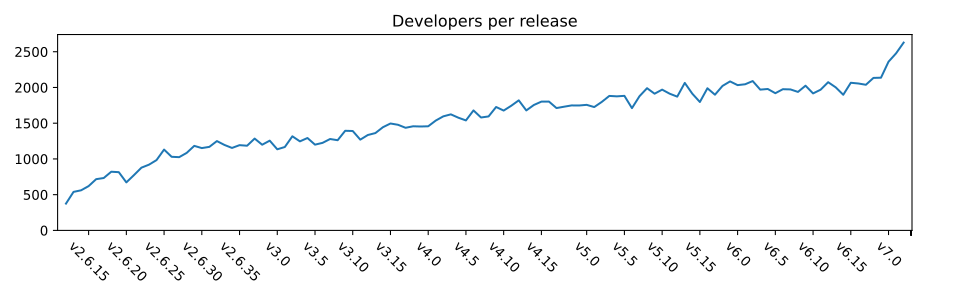
This plot illustrates the growth in the developer base since the beginning of the Git era.
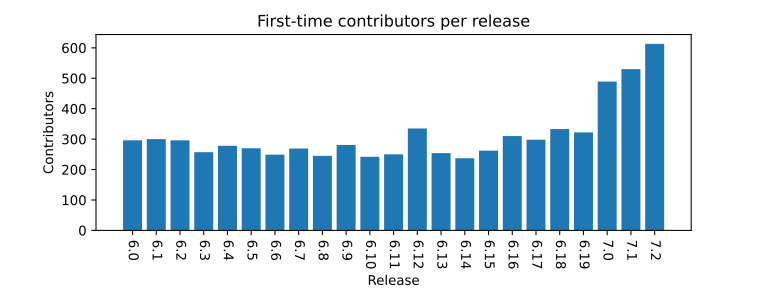
This chart highlights the surge in new participants and the record-breaking influx of first-time contributors.
Beyond direct code generation, LLMs are significantly impacting the kernel's bug-fixing pipeline. The 7.2 release contained 4,830 commits with 'Fixes' tags, indicating a bug introduced by a previous commit. A historical analysis shows a dramatic increase in these tags after the 5.9 release, a trend attributed to the widespread use of LLMs to scan and identify bugs in existing software. This shift raises questions about the long-term sustainability of the kernel's codebase; if LLMs enable developers to submit patches they do not fully understand, the community may face a future where the code is maintained by tools rather than human comprehension. Currently, nearly 14,000 changesets are already queued for the 7.3 release, suggesting this high-velocity, AI-influenced development cycle is likely to continue.
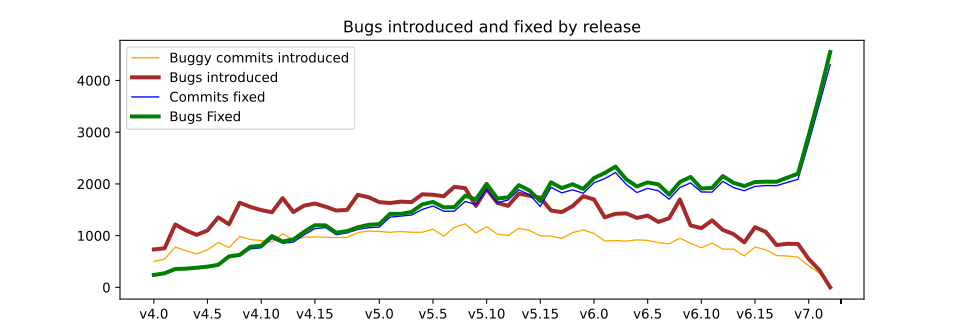
This figure supports the analysis of the dramatic increase in bug-fixing tags attributed to LLM-assisted scanning.