Laurentiu Raducu’s approach to learning complex subjects starts from a familiar frustration: language models often produce explanations that sound clear but remain too abstract to test. Rather than asking an LLM for another summary, he proposes a four-step workflow: have a coding assistant establish the topic’s foundations; ask a model to review that knowledge base for accuracy; turn the subject into a small, low-poly simulation; and publish the result so it can be inspected and revised. The method is presented through ChipTycoon, an interactive explanation of chip manufacturing that follows material from sand collection through fabrication and delivery to a data center.
The central idea is not simply that animation is more entertaining than text. A simulation forces the learner to represent states, transitions, inputs, and outputs. ChipTycoon moves a cart through manufacturing stages and changes what the cart carries as the process advances. That design can expose missing steps or unclear relationships that a bullet list might conceal. It also gives the learner something concrete to interrogate: if a stage cannot be represented, the underlying explanation may need revision. This is the practical advantage Raducu identifies, although the article does not provide experimental evidence that it produces better retention than reading or conventional study.
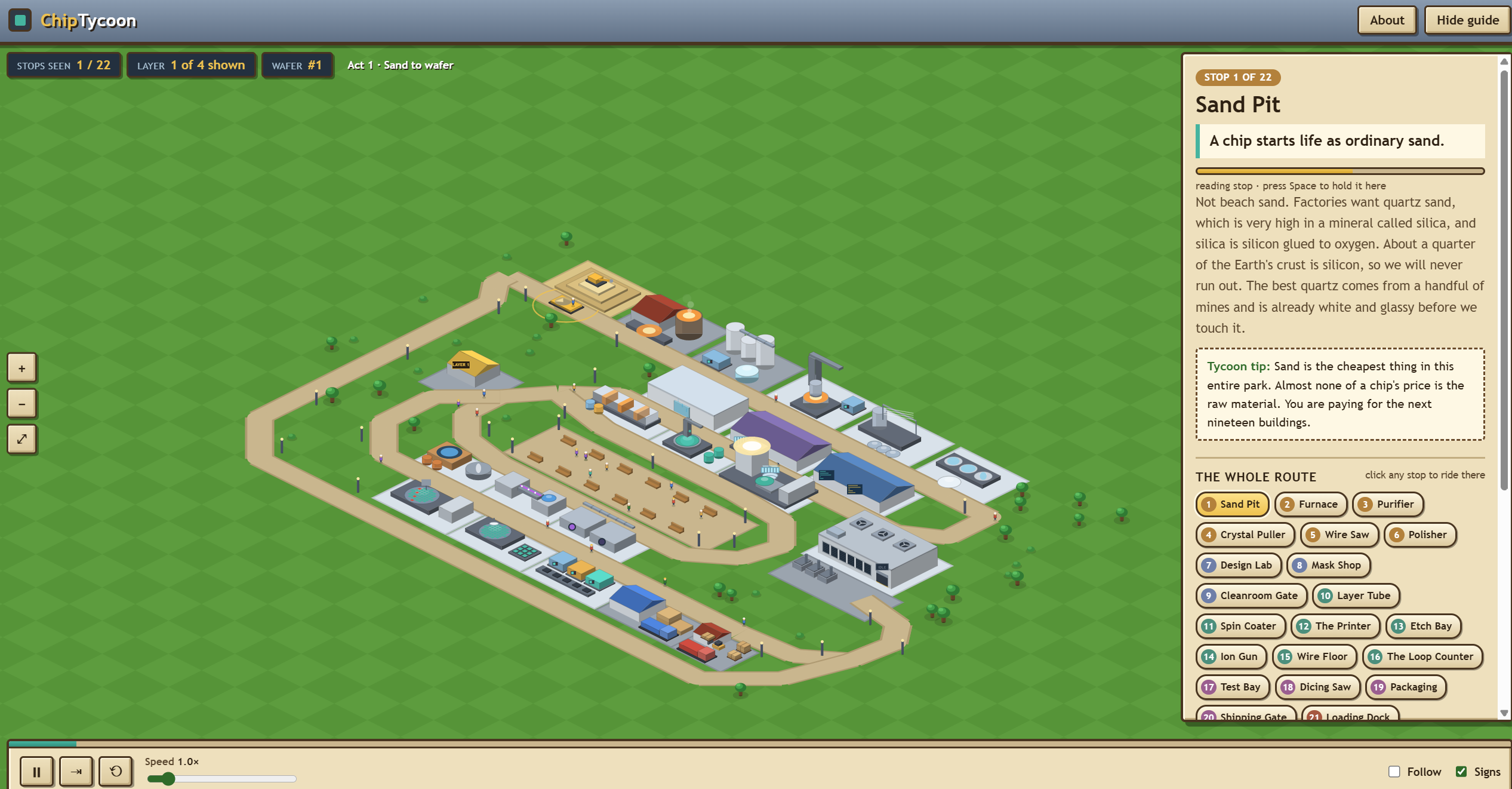
This source image directly supports the article’s explanation of how the cart’s changing contents make manufacturing stages visible and testable. Credit: laurentiugabriel.github.io.
The workflow’s second step is especially important. Raducu asks the model to review the knowledge base it created before building the visual layer. In principle, that separates fact-checking from presentation and makes errors easier to locate. It does not, however, make the result “100% accurate,” as the article describes it. A model reviewing its own output can repeat the same mistaken assumption, omit a relevant source, or treat an oversimplification as acceptable. Accuracy therefore depends on the quality of the underlying references and on whether a person checks the simulation’s claims against independent material.
The GitHub repository `learnscape` supplies a more disciplined version of the same concept. Its README describes isometric explainers in which a vehicle carries real state and each stop performs a real step of a simulation. The repository also calls for a “fidelity ledger” that labels numbers as computed, scaled, assumed, or deliberately faked. That distinction matters because a polished visual can imply precision that the model does not possess. A learner can see not only what the explainer claims, but which parts are measured, approximated, or invented for clarity.
`learnscape` also documents concrete engineering checks: JavaScript syntax validation and a headless Chromium smoke test covering all eight stations and a complete three-request run. Those checks establish that the supplied PacketPost example behaves as described; they do not validate the educational effectiveness of every subject built with the technique. The repository’s verified path is likewise narrower than a universal guarantee: it says the copy-based installation methods were tested, while the end-to-end plugin installation was not. That is a useful reminder to separate a working demonstration from a claim about all future uses.
Raducu’s separate GitHub repository, `unreal-game-assets-creation-skill`, shows another way to enrich a simulation by converting a prompt or photograph into a textured 3D asset. Its README describes a pipeline using Fooocus, Hunyuan3D-2, Blender, and optionally Unreal Engine. It also reports a practical constraint: on a Windows workstation with an RTX 4070 laptop GPU and 8 GB of VRAM, running the image and 3D services together caused memory pressure and much slower generation, so the skill stops one service before starting the next. This is evidence about that repository’s documented setup, not a general benchmark for all hardware or AI-generation tools.
For readers considering the method, the most defensible takeaway is procedural. Use an LLM to draft a topic map, challenge that map, implement a small model whose behavior can be observed, and maintain an explicit record of assumptions. Add questions or puzzles only after the underlying process is represented well enough to support them. The visual layer should clarify the model, not disguise uncertainty. The strongest version of this workflow is therefore not “trust the animation”; it is “make the claim executable, then inspect where the execution disagrees with the evidence.”
The source packet dates the primary article to August 9, 2026, matching the publication date supplied for the page. The article’s claims about personal usefulness and accuracy remain the author’s account. The supplied repositories corroborate that related tools and documentation exist, and they add details about simulation structure, fidelity labels, testing, and local GPU constraints. They do not establish comparative learning outcomes, prove that ChipTycoon is free of hallucinations, or show that every LLM-generated explainer is reliable. For a reader, the method is promising as a way to organize inquiry—but its educational value still has to be tested against the learner’s goals, sources, and ability to spot errors.