The secret ballot is designed to protect voter privacy by recording whether a person voted without revealing how they voted. In Georgia and other states, electronic ballot scanners assign a seemingly random number to each ballot for auditing purposes, then shuffle these numbers before releasing the records to prevent linking ballots to specific voters. However, a security vulnerability disclosed in 2022 revealed that the algorithm generating these numbers is deterministic and can be exactly reversed, allowing the original order in which ballots were cast to be recovered.
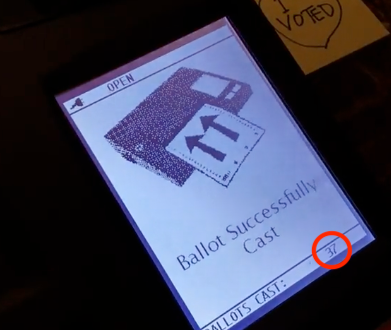
Illustrates the step where electronic ballot scanners assign a seemingly random number to each ballot for auditing purposes, as described in the article.
By combining the reversed ballot order with publicly available voter logs—such as early-voting lists or poll watcher records—it becomes possible to reconstruct how individuals voted. In an analysis of Georgia's May 2026 primary, the author used AI coding tools to automate this process, successfully recovering the cast order for 1.5 million ballots, which amounted to 98.9% of in-person votes across 114 of the state's 139 counties. In smaller counties, when paired with local check-in records, the approach could determine nearly every voter's specific ballot.
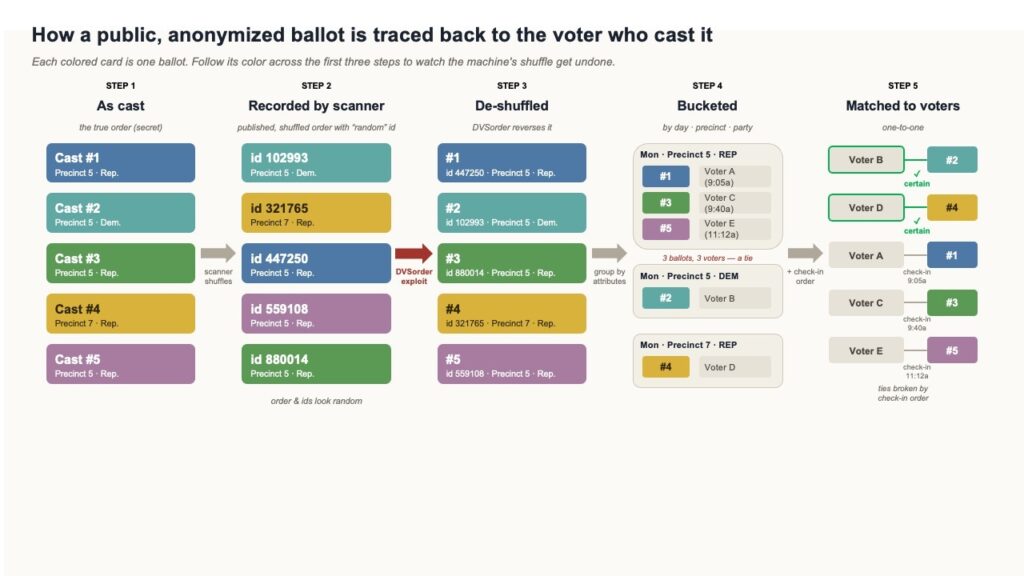
Shows the vulnerability exploitation steps: reversing deterministic ballot numbering and combining with public logs to break ballot secrecy, as detailed in the article.
Although a corrected version of the scanner software (version 5.17 or newer) was developed and certified in March 2023, the data analyzed for this study was from May 2026, indicating that many jurisdictions have not applied the update. The author notes that the emergence of accessible AI tools has lowered the technical barrier to exploiting such vulnerabilities, transforming what was once a niche attack into a practical threat. While maintaining public election records remains essential for verifiable outcomes, the failure to patch known privacy flaws means that the act of voting itself could compromise voter secrecy.