UTF-8 is a widely used character encoding that represents Unicode characters using between one and four bytes. While the original design of UTF-8 once supported up to six-byte sequences, it was restricted to four bytes in 2003 to align with UTF-16 constraints. UTF-8000 is an experimental proposal that seeks to remove this limit, allowing for code units of arbitrary length to accommodate an unlimited number of codepoints. The core mechanism of UTF-8000 involves splitting the highest bits of the first byte into self-synchronization bits and start bits. When a code unit exceeds the capacity of a single byte, the start bits are striped across subsequent continuation bytes. This approach maintains the prefix-free property of standard UTF-8, ensuring that the length of a code unit can be determined by reading the start bits, which indicate the sequence length. By using this method, UTF-8000 avoids the need for auxiliary punctuation between code units, preserving the self-synchronization and self-punctuation characteristics of the original standard. The specification maintains the existing rules for ASCII compatibility and forbids overlong encodings—where a character is represented using more bytes than necessary—to prevent security vulnerabilities such as those that could arise if null bytes were improperly handled by C functions like strcpy. Despite its technical design, the proposal faces practical challenges. Implementing support for arbitrarily large code units introduces potential risks, such as buffer overflow vulnerabilities, if software does not enforce strict limits on input size. Furthermore, because the standard requires reading the start bits to determine length, extremely long sequences could complicate parsing and memory management compared to the fixed-length limits of current standards.
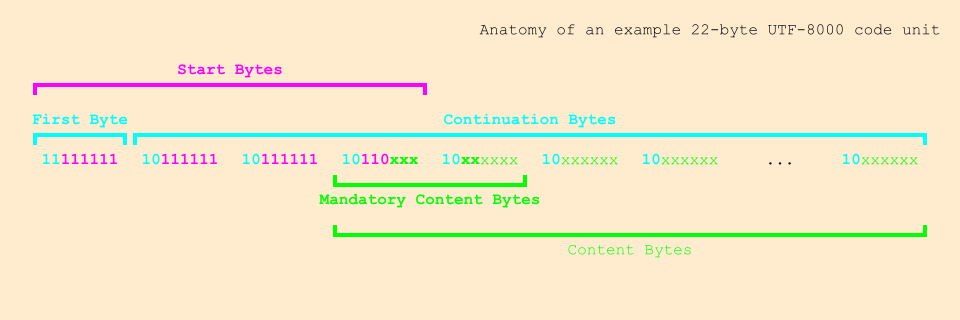
The article describes how UTF-8000 splits bits across bytes to maintain prefix-free properties, which is visually clarified by this anatomy diagram.
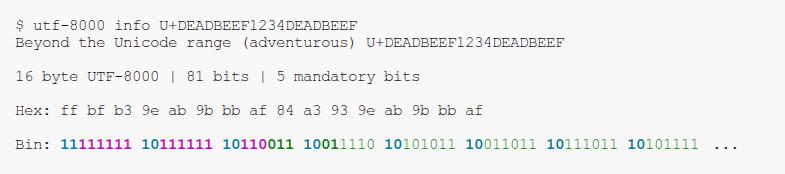
This informational graphic provides a concrete example of the encoding mechanism discussed in the proposal, helping to visualize the theoretical unlimited range.