The letter W is a historical compromise. Its shape, name, and many of its modern uses record separate encounters among Latin, Germanic languages, Old English, French, and changing English pronunciation. The result is not an arbitrary oddity but a layered writing system in which one mark can represent a sound, preserve an older spelling, or help readers recognize a vowel that has shifted.
The story begins after imperial authority in western Europe fragmented. Germanic-speaking rulers continued to use prestigious Latin for official writing, but Latin had no dedicated letter for the consonant heard at the beginning of English water and want. In Latin, the character V had moved away from its older /w/ value, while the Greek letter that once represented the sound had disappeared. Scribes therefore needed a practical way to record Germanic names and words.
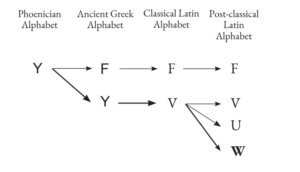
According to Danny Bate’s account, scribes in Francia began doubling U for /w/ from about the sixth century. Medieval examples include forms such as UUandebertus and UUaldemarus. Over time, the two characters were written as a connected unit, and by at least the 11th century the combination had become recognizable as W. This sequence also explains why English calls it double U: the fusion predated the later separation of U and V into distinct alphabetic letters. French double vé reflects that same history from a different naming tradition.
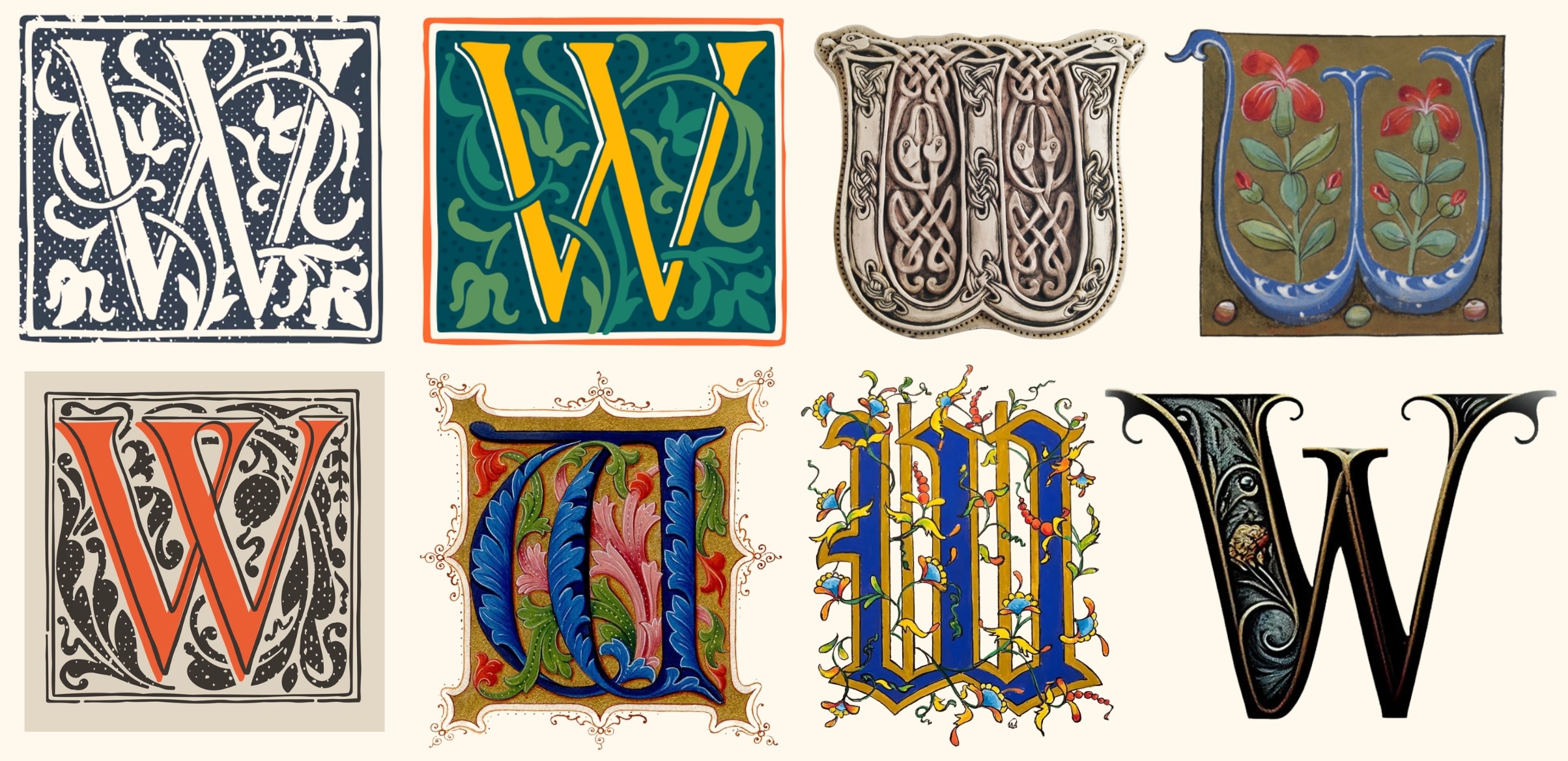
The medieval spelling illustrates how two U characters fused into the letter now called double U.
England did not adopt the doubled form without competition. Old English writers sometimes used a single U, but long sequences could become difficult to read. They also borrowed the runic character Ƿ, called wynn, which became standard in the Wessex writing tradition and appears in the surviving manuscript of Beowulf. Wynn even survived on objects such as a ninth- or tenth-century Kentish dagger. It was not an inherently inferior solution; it lost because French and Latin scribal conventions continued to favor W, creating pressure for English spelling to conform.
The screenshot accompanies the discussion of competing medieval spellings and the runic wynn.
W’s role expanded after it returned to English. Some words acquired it through sound change: Old English fugol became fowl, while the consonant in forms related to Old English sagu developed into the final sound of saw. In other words, W does not simply stand for a consonant. In town, cow, and owl, it helps mark vowels altered during the Great Vowel Shift. English also developed a loose preference for OW at the end of a word or syllable and OU elsewhere, although exceptions such as brown and crown show that the pattern never became a strict rule.
That history helps explain a familiar reader concern: why English spelling often seems to preserve several competing systems rather than one consistent code. A written letter may reflect an older pronunciation, a scribe’s attempt to avoid visual confusion, or a later convention for distinguishing related words. Flower and flour illustrate how optional spellings could become useful contrasts, even though they share an origin. Modern spelling is therefore partly phonetic, partly historical, and partly conventional; it cannot be decoded by applying one sound-to-letter rule everywhere.
W also helps explain why was does not rhyme with has, wand with hand, or warm with arm. The consonant /w/ is produced with rounded lips and the back of the tongue, and in many varieties of English it has rounded or pulled backward the vowel immediately following it. This is a claim about the history described in the source, not a universal description of every accent. The article notes that North American mergers and other regional developments can alter particular vowels, while the basic contrast between many W-words and their W-less counterparts remains audible.
The change was gradual. The source argues that W-rounding may have begun in the 15th century and was initially limited to frequent or unstressed words such as was. Evidence from poetry attributed to Chaucer and Shakespeare suggests that the affected words did not yet behave uniformly in their speech: Shakespeare rhymed was with glass and warmed with disarmed. Byron’s early-19th-century rhymes provide another historical clue. These examples do not prove that every speaker followed the same pronunciation, but they show why spelling can preserve relationships that modern ears no longer hear.
The article’s evidence is primarily its reconstruction of manuscript spellings, named historical forms, and literary rhymes. It supports a coherent account of how W entered and changed within English, but it does not establish a single, uninterrupted pronunciation for all English speakers. That limitation matters: the useful conclusion is not that English spelling is senseless, but that its irregularities often record different stages of contact and change. W is odd because it carries several histories at once, not because it was designed to be inconsistent.