The article introduces what author Baldur Bjarnason calls the 'LLMentalist Effect' – the phenomenon where users perceive chat-based large language models as possessing genuine intelligence and reasoning abilities. Bjarnason, drawing from his research on language models in software businesses, contends that this perception stems not from any inherent cognitive capabilities in the models but from psychological mechanisms identical to those used by psychics in cold reading performances. He emphasizes that LLMs are mathematical models of language tokens that generate statistically plausible responses without thinking or reasoning in any human sense.
Bjarnason details how the LLMentalist Effect mirrors the six-stage process of a psychic's con: first, the audience selects itself by being pre‑disposed to believe in AI capabilities; second, the scene is set through hype and expectations that make vague outputs seem meaningful; third, the psychic narrows the demographic by making gestures or statements that elicit visible reactions, analogous to how prompts elicit specific user responses; fourth, the mark is tested with follow‑up questions that sound specific but are statistically generic; and crucially, the fifth stage involves a subjective validation loop where validation statements – seemingly specific phrases that are actually statistically generic, such as Forer/Barnum statements like 'you tend to be hard on yourself,' vanishing negatives, rainbow ruses, and statistical guesses – are accepted as accurate because users relate them to their own experiences.

This image corresponds to the audience selection stage described in the article, where users predisposed to trust AI are more susceptible to the LLMentalist Effect.

This image illustrates the scene‑setting stage of the psychic cold reading analogy, where hype primes users to interpret generic AI responses as personally relevant.

Matches the article’s description of how prompts narrow the user’s focus, making the AI’s output appear tailored to a specific subset.
The analysis reveals a significant paradox: individuals who consider themselves intelligent or analytically minded may be particularly susceptible to the LLMentalist Effect. Rather than dismissing the illusion, such users often employ considerable creativity and intelligence to rationalize the model's apparent abilities, becoming 'the biggest, most lucrative marks' by defending the psychic's claim of powers. This creates a feedback loop where the more cooperative the user is with the illusion, the stronger the effect becomes over time, leading Bjarnason to suggest that many proposed LLM use cases now appear 'borderline fraudulent pseudoscience' to critics, as the perceived intelligence is ultimately a statistical trick rather than genuine cognitive ability.
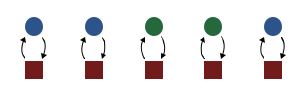
This image supports the article’s explanation of the validation loop and feedback effect, where cooperative users strengthen the LLMentalist Effect over time.