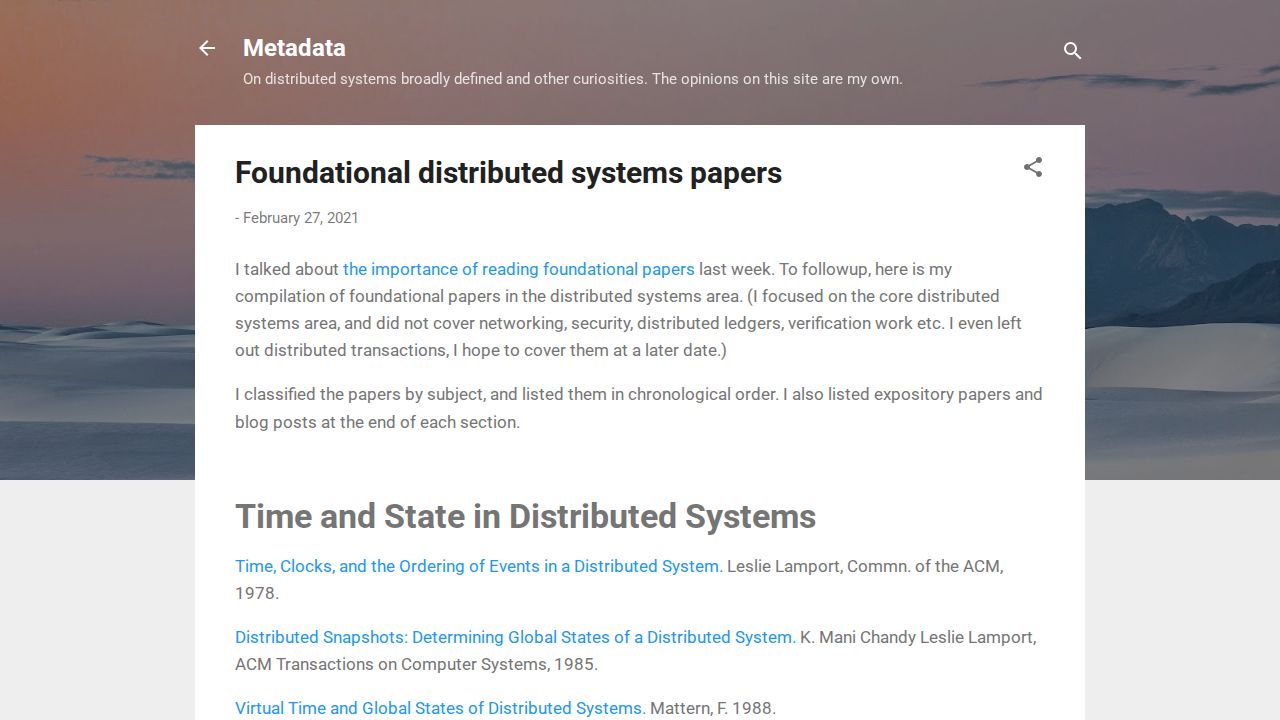
The architecture of modern cloud computing is built upon a specific lineage of academic research that solves the fundamental problem of how independent computers can agree on a single state. These foundational works, spanning from the late 1970s to the present, establish the mathematical and logical boundaries for everything from global databases to scalable web services.
Time and State in Decentralized Networks
A primary challenge in distributed systems is the lack of a shared, perfectly synchronized clock. Leslie Lamport's 1978 paper, 'Time, Clocks, and the Ordering of Events in a Distributed System,' introduced the concept of logical clocks to determine the sequence of events based on causality rather than absolute time.
Building on this, research into distributed snapshots and virtual time allowed systems to determine 'global states'—a consistent view of what every node in a network is doing at a specific moment. These concepts are essential for ensuring that data remains coherent across multiple machines.
“Distributed systems need radically different software than centralized systems do.”
— Foundational distributed systems papers
Impossibility Results and the CAP Theorem
Distributed systems are governed by strict mathematical limits. The FLP impossibility result (1985) demonstrates that it is impossible to guarantee consensus in an asynchronous system if even one process fails.
The CAP theorem further defines the operational boundaries of these systems. It posits that a distributed system can only provide two out of three guarantees simultaneously: Consistency (all nodes see the same data), Availability (every request receives a response), and Partition Tolerance (the system continues to operate despite network failures).
The Evolution of Consensus Protocols
To overcome these limitations, researchers developed consensus algorithms to ensure all nodes agree on a shared log of operations. Early methods like Viewstamped Replication (1988) and the 'Part-Time Parliament' (Paxos, 1998) provided the blueprints for highly available systems.
More recent developments have focused on practical scalability and Byzantine Fault Tolerance (BFT), which protects against malicious actors. Modern implementations like ZooKeeper and Tango utilize these theories to provide wait-free coordination for internet-scale infrastructures.
Modeling and Abstraction in System Design
Understanding these systems requires a distinction between 'modularity abstraction' and 'modeling abstraction.' While modularity focuses on hiding internal details through APIs and layers, modeling abstraction involves understanding the underlying behavior and state transitions of the system.
Effective system design requires the ability to model these complex interactions, often using formal methods like TLA+ to verify that a protocol will behave correctly under all possible failure conditions.
Limitations of the Foundational List
While the provided list covers core distributed systems, it explicitly excludes networking, security, distributed ledgers, and verification work. It also leaves out distributed transactions, which are noted as a subject for future coverage.
The list serves as a starting point for a principled, foundations-up study of the field, which the author suggests can take several months to master in a first pass.
What Hacker News readers are saying
- Experience: One commenter suggested several additional 'deeper cut' papers, including those on chain replication and the formalization of the CAP theorem, to supplement the list. comment ↗
- Experience: Another user pointed out that Joe Armstrong's PhD thesis on reliable distributed systems is a notable omission from the collection. comment ↗
- Experience: A commenter noted that while some papers are foundational, others like consistent hashing or hybrid logical clocks are also highly relevant for practical applications. comment ↗
- Skeptical: One commenter questioned whether chain replication remains the primary method for cloud-scale data replication today, noting they could only confirm its use at Facebook. comment ↗
Summarized opinions from the Hacker News thread, not verified facts. Read the full discussion ↗