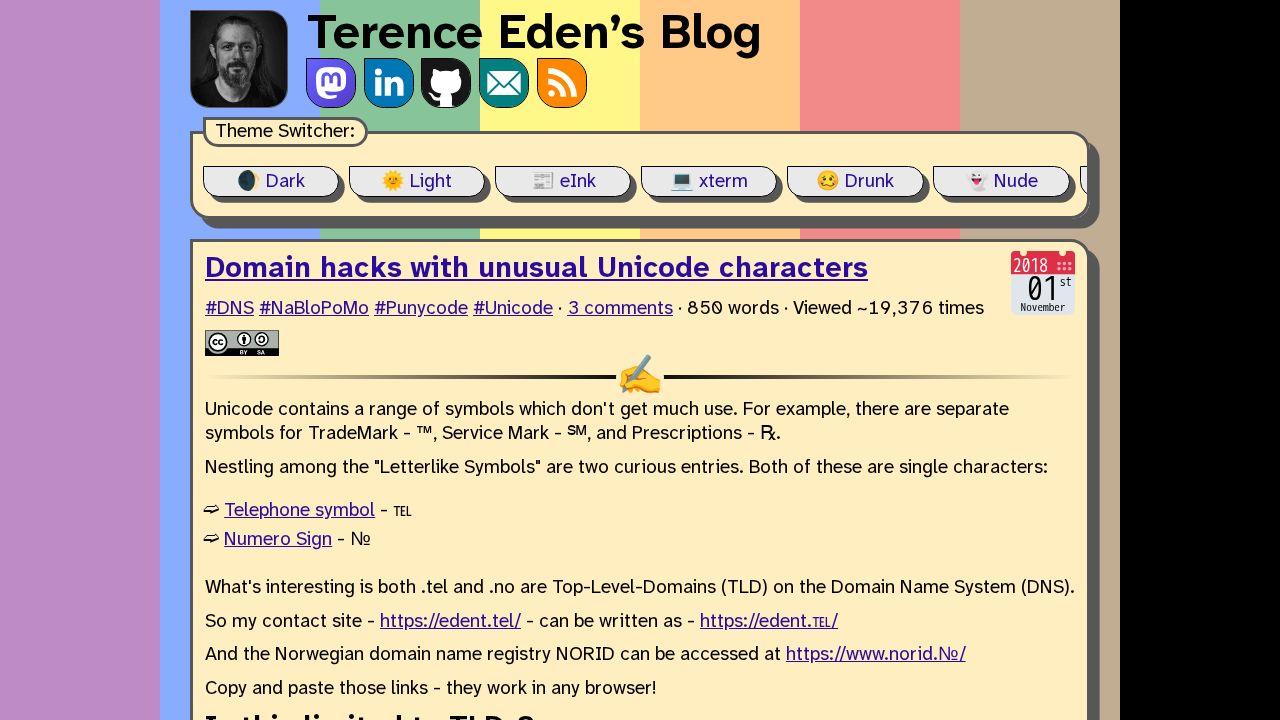
Modern web browsers can resolve domain names containing unusual Unicode characters by using a normalization process known as IDNA2008. This system allows characters that appear as symbols—such as the telephone sign (℡) or the Numero Sign (№)—to be mapped to standard Top-Level Domains (TLDs) like .tel and .no. For example, a site hosted at edent.tel can be accessed via the URL https://edent.℡/. This mechanism works because the browser performs the conversion before the DNS query is sent; the DNS servers themselves do not recognize the symbols directly but instead receive the normalized plain-text equivalent.
This functionality is not restricted to the TLD portion of a web address; it can be applied to subdomains and the entire domain name. Users can create 'fancy' URLs using various scripts and styles, including Fraktur, Math Bold, Monospace, and Double Struck characters. For instance, a domain can be rendered in a script font or a bold italic style while remaining functional in modern browsers and command-line tools like curl and wget. This allows for highly stylized web addresses that differ significantly from the standard alphanumeric strings typically seen in URLs.
However, these Unicode-based domain hacks come with significant practical limitations and security implications. Many social media platforms, such as Twitter and Facebook, do not recognize these symbols as valid URLs and will refuse to auto-link them. Additionally, some standard command-line tools like dig and host cannot interpret the symbols and will return an NXDOMAIN error. From a security perspective, these 'homograph' style domains can be used to evade URL filters and complicate visual inspection. Because the symbols can look nearly identical to standard characters or be visually confusing, they provide a method for creating deceptive links that might bypass traditional security checks for phishing.