In the context of historical material culture, urine was a versatile and essential chemical agent. While often overlooked in modern historical narratives, it played a critical role in a wide array of industries, including the production of gunpowder, the curing of tobacco, the tanning of hides, and the bleaching and dyeing of textiles. The specific term 'lant' refers to aged urine that was intentionally collected and set aside to ferment. This fermentation process increased its ammonium content, transforming it into a valuable and irreplaceable resource for specific chemical manufacturing tasks.

The bourdaloue represents the historical method of collecting the biological byproduct that became the industrial resource known as lant.
One of the most notable industrial applications for lant was in the production of gunpowder. Gunpowder requires three primary ingredients: saltpeter, charcoal, and sulfur. Saltpeter, the most difficult component to cultivate, was historically produced as a byproduct of bird droppings and human urine. In 17th-century England, the production of saltpeter was a royal monopoly. To ensure a steady supply, King Charles I issued proclamations requiring families to collect urine from both humans and livestock. These resources were handed over to 'Saltpeter men,' who were authorized to dig up urine-soaked floors in stables, cellars, and dove-houses. To facilitate this, it was even made illegal to cover these floors with anything other than 'mellow earth.'
Despite its industrial importance, the distribution of lant was often informal. Because urine was a readily available byproduct, many industries likely exploited it as a free resource rather than through a formal market. However, the demand for purity in certain sectors led to specific regulatory and technological responses. For example, during the Napoleonic Wars, the collection of urine for gunpowder in Glasgow became so significant that households were paid for the volume provided. This prompted a challenge where citizens attempted to dilute the product with water to increase their payout. In response, scientific instrument maker William Twadell reportedly invented the hydrometer to ensure that gunpowder manufacturers were not sold 'spurious and adulterated' products. This highlights how a common biological byproduct became a regulated, measured, and technologically monitored commodity in the history of industrial chemistry. (Source: primary) [Note: While the primary source discusses the general history of lant, a commenter on the Hacker News thread noted that bacteria would convert urine to nitrites during the aging process, a mechanism that explains the chemical transition to saltpeter.]
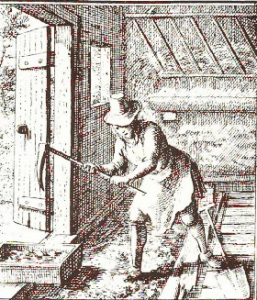
This image illustrates the physical process of 'Saltpeter men' digging up urine-soaked floors to collect materials for gunpowder production.