Cormac McCarthy proposes that human language did not evolve through standard Darwinian selection but instead functioned as a 'parasitic invasion' of the human brain. This theory suggests that language appeared only once in human history, occupying brain regions that were not originally structured to receive it, and created a permanent tension between our conscious speech and our underlying biological systems.
This portrait identifies the author of the theory regarding language as a parasitic invasion.
The Unconscious as a Biological Machine
McCarthy defines the unconscious mind not through psychological jargon, but as a biological system: a machine for operating an animal. It handles a vast array of duties, from scratching an itch to solving complex mathematical problems that the conscious mind cannot easily access.
This 'Night Shift' of the unconscious occurs without the use of numbers, pencils, or erasers. It is a process opaque to conscious access, where the mind solves problems in a way that remains a mystery to the conscious observer.
“To put it as pithily as possibly—and as accurately—the unconscious is a machine for operating an animal.”
— The Kekulé Problem - Nautilus
The Parasitic Origin of Language
Unlike vision, which has multiple evolutionary histories, McCarthy argues that language appeared only once in a single species. He suggests that language acted like a parasitic invasion, occupying areas of the brain that were the least dedicated to specific functions.
Because language is not a biological system, it did not arrive via Darwinian selection. Instead, it was an acquired inheritance of ideas that spread through the species almost instantaneously once the fundamental concept of symbolic substitution was understood.
The Kekulé Problem and Symbolic Communication
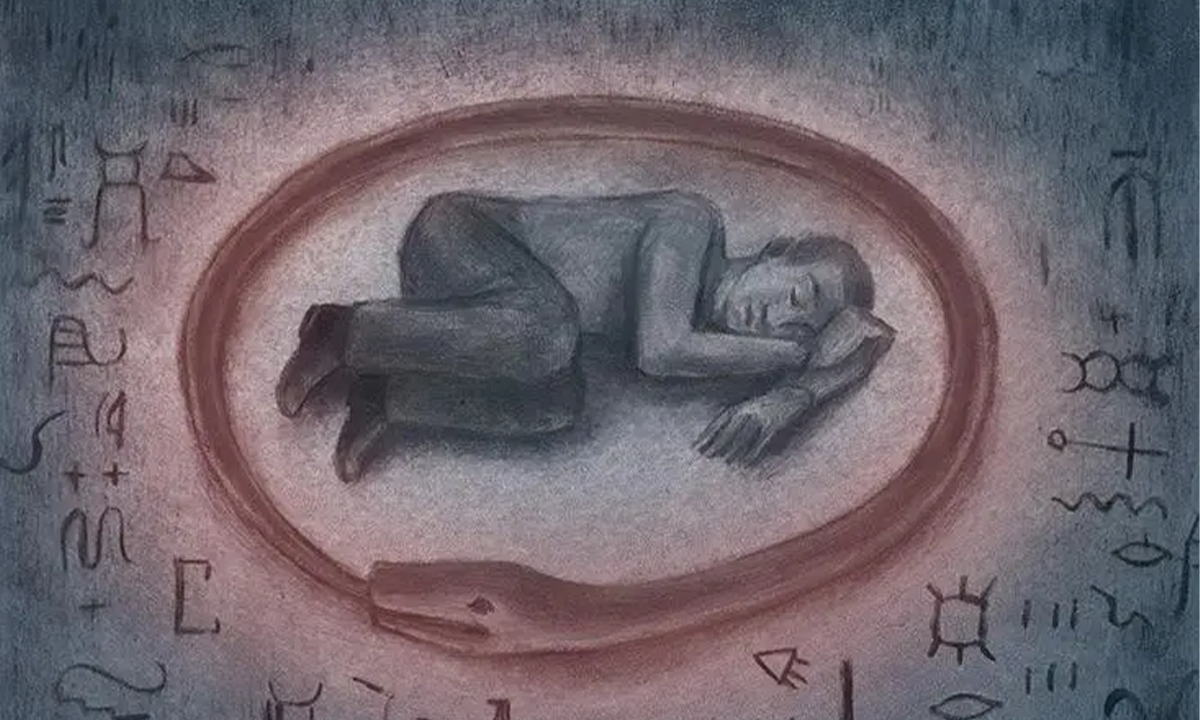
The 'Kekulé Problem' refers to why the unconscious mind uses images and metaphors—such as the Ouroboros snake—rather than direct linguistic statements. Because the unconscious understands language perfectly, it does not need to use it to solve problems; however, it lacks the tools to speak to the conscious mind directly.
This visual supports the discussion of the 'Kekulé Problem' and the transition to symbolic communication.
The mind must grammaticize facts and convert them into narratives to make them accessible. This creates a tension where the unconscious feels a 'moral compulsion' to educate the conscious mind through the medium of dreams and infection because it cannot simply provide a direct answer.
Physical Trade-offs and Uncertainties
The rapid adoption of language came with significant physical costs. The downward movement of the larynx allowed for the manufacture of speech but resulted in a species-wide vulnerability to choking and left humans as the only mammals incapable of swallowing and vocalizing at the same time.
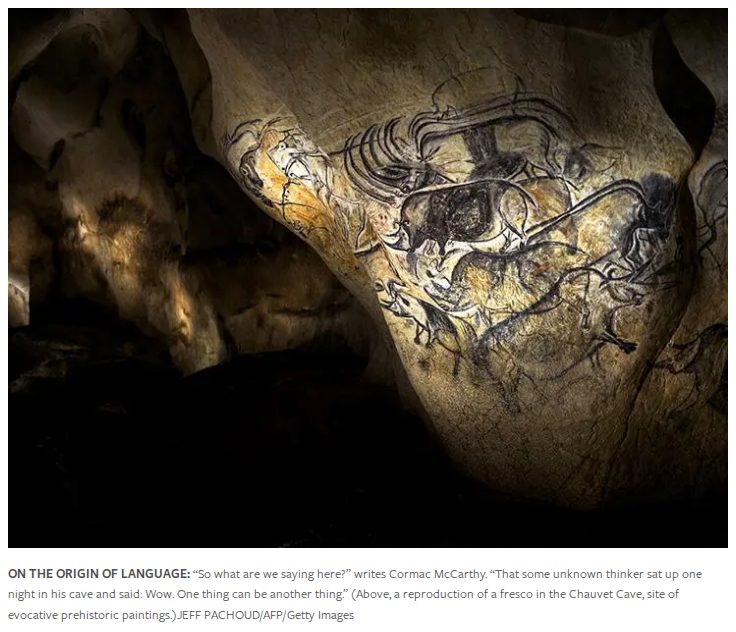
While the exact timing of language's origin remains debated, McCarthy points to the Blombos Cave graphics as evidence of a period roughly 100,000 years ago. The precise mechanism of how the unconscious 'knows' when the conscious mind is struggling remains a mystery 'opaque to total blackness.'
The Core of Symbolic Thought
The invention of language was understood at once to be incredibly useful. The central idea—that one thing can be another thing—is the root of all human linguistic capability, allowing for the rapid spread of symbolic thought across mountains and oceans.